
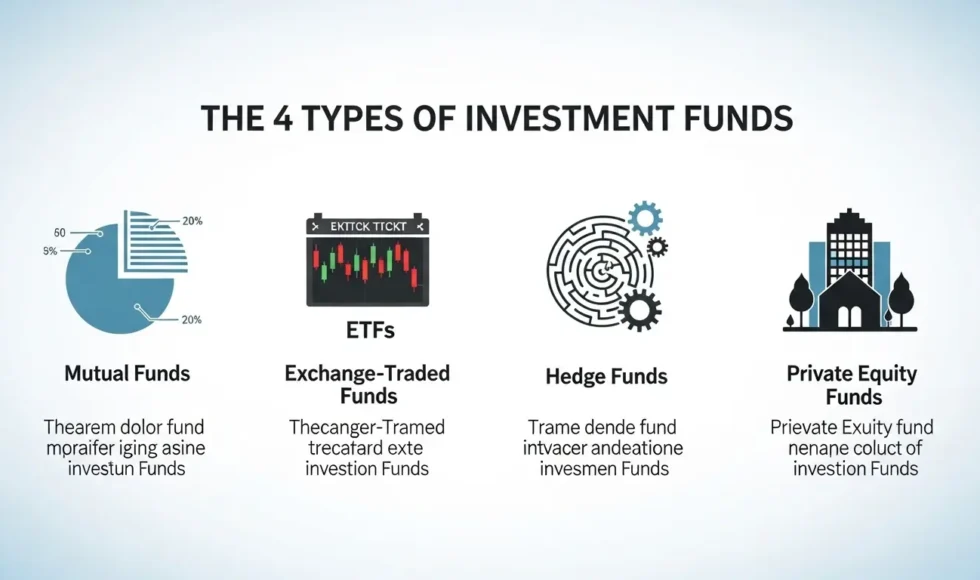
For individuals and businesses looking to grow capital strategically, investment funds offer a structured and professionally managed route into the financial and asset market. Whether the goal is capital preservation, long-term growth, income generation, or participation in large-scale opportunities, understanding the core categories of funds is essential before making any financial commitment.
In markets like Panama, where local and international investors often seek diversified opportunities, investment funds are increasingly relevant for those exploring professional wealth allocation, structured project investment, and institutional-grade portfolio management.
At a practical level, an investment fund pools money from multiple investors and allocates it across selected assets based on a defined strategy. This allows investors to access opportunities that may otherwise require larger capital, deeper market expertise, or direct management involvement.
This article explains the 4 main types of investment funds, how each one works, and what investors should evaluate before choosing the right option.
Understanding Investment Funds and Their Purpose
Investment funds are designed to simplify access to financial and asset-backed opportunities by placing capital under professional management. Rather than investing individually into a single stock, bond, project, or asset, investors participate in a broader structure that spreads risk and follows a predefined investment objective.
For many individuals and institutions, investment fund services provide more than access to assets. They also offer portfolio planning, due diligence, risk management, and strategic oversight. This is especially important in international markets where cross-border structuring, legal compliance, and asset evaluation can significantly influence performance.
Funds may be built around liquid financial products, income-generating assets, private equity opportunities, or growth-focused ventures. The right structure depends on the investor’s financial goals, risk appetite, and timeline.
The 4 Main Types of Investment Funds
While there are many subcategories in the global investment landscape, most fund structures generally fall into four primary groups.
1. Mutual Funds
Mutual funds are one of the most widely recognized forms of pooled investing. They collect capital from multiple investors and allocate it into a diversified portfolio that may include equities, bonds, money market instruments, or a combination of these.
These funds are usually managed by professional fund managers who make allocation decisions based on the fund’s stated objective.
How Mutual Funds Work
When an investor buys into a mutual fund, they purchase units or shares of the fund rather than owning the underlying assets directly. The value of the investment rises or falls based on the performance of the overall portfolio.
Mutual funds are often attractive to investors who want broad diversification and relatively easy entry into managed investing without handling individual asset selection.
Why Investors Choose Mutual Funds
Mutual funds are often suitable for:
- Long-term wealth accumulation
- Retirement planning
- Income and balanced portfolio strategies
- Investors seeking lower complexity
For investors evaluating structured investors services, mutual funds often represent a starting point because they are familiar, regulated, and generally accessible.
2. Exchange-Traded Funds (ETFs)
Exchange-Traded Funds, commonly known as ETFs, are similar to mutual funds in that they pool investor capital into a diversified portfolio. However, unlike mutual funds, ETFs trade on an exchange much like individual stocks.
This means they can be bought and sold throughout the trading day at market prices.
What Makes ETFs Different
ETFs are often designed to track a specific index, sector, commodity, region, or investment theme. Some ETFs are passive, meaning they aim to mirror market performance, while others are actively managed.
They have become popular among investors who want flexibility, liquidity, and lower operational costs compared to some traditional fund models.
Key Advantages of ETFs
ETFs are often preferred because they offer:
- Easy diversification
- Transparent holdings
- Intraday liquidity
- Access to global sectors and themes
For Panama-based and international investors seeking efficient market exposure through professional investment fund services, ETFs can be a practical option when the objective is flexible portfolio construction.
3. Hedge Funds
Hedge funds are more sophisticated investment vehicles typically designed for high-net-worth individuals, institutional investors, or experienced participants seeking advanced strategies and potentially higher returns.
Unlike mutual funds or ETFs, hedge funds often use more complex investment techniques, including leverage, derivatives, short selling, and concentrated asset positioning.
How Hedge Funds Operate
Hedge funds are usually less accessible to retail investors and often require higher minimum capital commitments. Their primary objective is often absolute return, meaning the fund seeks to generate gains regardless of broader market direction.
These funds may invest across multiple asset classes, including equities, private placements, structured debt, commodities, and alternative assets.
When Hedge Funds May Be Relevant
Hedge funds may appeal to investors who are looking for:
- Active risk-managed strategies
- Alternative portfolio diversification
- Exposure to complex market opportunities
- High-level asset allocation support
For investors involved in larger-scale project investment or cross-border financial structuring, hedge fund participation may align with more advanced capital deployment strategies.
4. Private Equity and Venture Capital Funds
Private equity funds and venture capital funds are often grouped within the broader category of private market investing. These funds do not typically invest in publicly traded securities. Instead, they allocate capital into private businesses, growth-stage enterprises, acquisitions, and strategic expansion opportunities.
This category is especially important for investors interested in business growth, ownership participation, and long-term value creation.
Private Equity vs Venture Capital
Although they are closely related, there is a distinction between the two.
Private Equity Funds
Private equity funds usually invest in established businesses that have the potential for operational improvement, expansion, restructuring, or acquisition-led growth.
Venture Capital Funds
Venture capital funds focus on early-stage or high-growth companies that show strong innovation or market potential. This is where venture capital investment becomes particularly relevant for investors seeking exposure to emerging businesses with scalable upside.
Professional venture capital service providers often help investors assess startup viability, market positioning, management strength, and long-term growth potential before capital is committed.
Why These Funds Matter
Private equity and venture capital funds are attractive for investors who want:
- Access to private market opportunities
- Participation in business growth
- Strategic capital deployment
- Long-term, high-potential investment exposure
For many international investors, this category aligns well with a structured investment group approach, where capital is pooled to target selected industries, business ventures, or regional growth opportunities.
How These Fund Types Relate to Real Asset and Group Investment Strategies
In many cases, investment funds are not limited to traditional financial instruments. They may also support real asset structures, strategic lending, and private opportunity vehicles.
For example, investors working with an investment property group may participate in funds tied to real estate development, income-generating properties, land repositioning, or hospitality-linked assets. These structures often appeal to investors seeking tangible asset exposure combined with professional management.
Similarly, certain fund arrangements may also intersect with debt-backed or cross-border financing strategies, especially where capital is used for expansion, development, or institutional funding. In these cases, concepts related to an international investment loan may become relevant, particularly in jurisdictions with active international investor participation such as Panama.
Which Type of Investment Fund Is Best?
There is no universal answer because the right fund depends on the investor’s objectives.
A conservative investor may prefer a diversified mutual fund or ETF. A growth-oriented investor may look toward private equity or venture capital investment. An experienced or institutional investor may evaluate hedge funds for more specialized strategy exposure.
The key is not simply choosing a popular fund category, but selecting one that aligns with:
Investment Goals
Is the objective income, capital appreciation, preservation, or strategic ownership?
Risk Tolerance
How much volatility or illiquidity can the investor reasonably accept?
Investment Horizon
Is the capital needed in the short term, or can it remain allocated for several years?
Professional Oversight
Does the investor have access to credible investors services and qualified advisory support?
In any market, but especially in international financial environments, the quality of fund structuring and management is just as important as the category itself.
What Investors in Panama Should Consider
Panama continues to attract local and international interest due to its strategic location, business environment, and growing relevance in cross-border investment planning. However, selecting the right fund in this market requires more than just identifying a high-return concept.
Investors should evaluate:
- Regulatory framework and legal structure
- Transparency of fund operations
- Asset quality and strategy credibility
- Manager experience and track record
- Alignment between risk and expected return
A professionally guided approach to investment fund services helps reduce uncertainty and supports more informed capital decisions, particularly where funds are linked to private opportunities, business growth, or structured regional expansion.
Conclusion
Understanding the four main types of investment funds is a critical first step for anyone seeking to build or diversify capital through professionally managed opportunities. Mutual funds, ETFs, hedge funds, and private equity or venture capital funds each serve a different purpose and investor profile.
The best choice depends on financial goals, risk tolerance, and the type of market exposure an investor wants to achieve. In a dynamic and internationally connected environment like Panama, well-structured fund participation can offer meaningful access to strategic growth, diversified asset exposure, and long-term value creation.